Introduction


Mata Elang is the evolution of the Mata Garuda Internet Monitoring Project for Indonesia. This project was initialized as a private repository in 2018 by Cyber Security Research Group (CSRG) - Politeknik Elektronika Negeri Surabaya (PENS). Currently, Mata Elang is a collaboration research between PENS, Universitas Indonesia (UI), and Badan Riset dan Inovasi Nasional (BRIN)with supports from Japan International Cooperation Agency (JICA).
About Mata Elang version-2.1.0
The Cyber Security Research Group of the Polytechnic Elektronika Negeri Surabaya and the Fairness Research Group at the Universitas Indonesia are proud to officially present Mata Elang Stable Release version 2.1, the latest update to their open-source Network Intrusion Detection System (NIDS) platform. With the approval of the Mata Elang OSS Projects Board of Directors, the development of the Mata Elang Community CSRG PENS was designated as Mata Elang Stable Release version 2.1. This version features several important enhancements, particularly in the security of inter-component communications through the implementation of mutual TLS (mTLS), more structured certificate management, an update of the Docker sensor image to "v2.1-debian," and improvements to the Defense Center component. With these enhancements, Mata Elang version 2.1 can also be an alternative solution for Security Operations Centers (SOCs) in supporting the monitoring, detection, and security of Intra-Government Networks. Its presence is expected to further strengthen the national cybersecurity ecosystem through an open-source solution that is adaptive, transparent, and easily scalable to operational needs. This release was developed by the Elang Community CSRG PENS Research Team, led by Dr. Ferry Astika S. as Research Team Leader. The core team consists of Fadhil Yori, M. Alfiyan, Rifky Yudha, and M. Izzat, with support from Krisna Wahyu, M. Prajitno, and M. Azis.
Key Features
- 🚀 Effortless Setup: Mata Elang provides a seamless deployment experience using Docker Compose, making it easy to install and manage across different environments. Whether you're deploying on a single machine or a cloud-based infrastructure, the setup process is streamlined to reduce complexity and ensure a quick start.
- 🔍 Advanced Intrusion Detection with Snort: At its core, Mata Elang integrates Snort, a leading Network Intrusion Detection System (NIDS), to monitor and analyze network traffic for potential threats. It leverages real-time packet inspection and rule-based detection to identify malicious activities and security breaches.
- 📊 Big Data Analytics for Threat Intelligence: Unlike traditional NIDS solutions, Mata Elang is built on a Big Data platform, allowing it to process and store massive amounts of network traffic data efficiently. This ensures better detection accuracy, supports long-term trend analysis, and enables real-time correlation of security events.
- 🏗 Scalable & Distributed Architecture: Mata Elang is designed for scalability, enabling security teams to deploy sensors across multiple network nodes. Its distributed architecture ensures that even high-traffic networks can be monitored efficiently without performance bottlenecks.
- 🛡 Real-Time Threat Detection & Response: By leveraging machine learning and behavioral analysis, Mata Elang can detect anomalies in network traffic and provide real-time alerts. The system is capable of adapting to new and evolving cyber threats, offering a proactive approach to network security.
Project Architecture
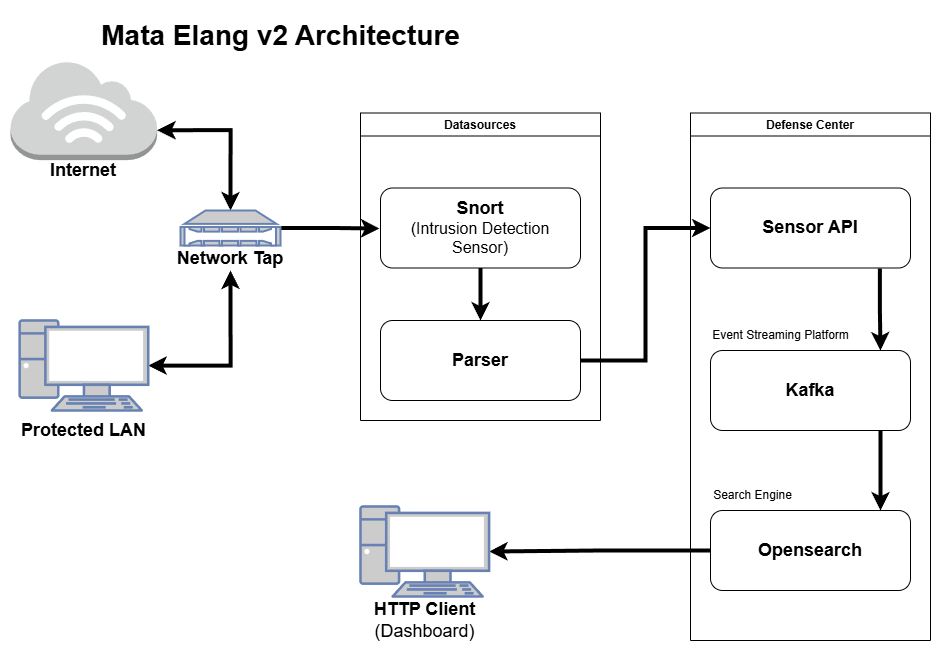
Component Functionality
Network Traffic Monitoring
- Network Tap: This component passively captures incoming and outgoing network traffic from the Protected LAN (internal network) and sends it to the Snort Intrusion Detection Sensor for analysis.
- The goal is to monitor all data packets without interfering with normal network operations.
Intrusion Detection & Data Parsing
- Snort (Intrusion Detection Sensor): This is the core detection engine responsible for analyzing network packets and identifying potential security threats based on predefined rules.
- If Snort detects a suspicious packet, it forwards the information to the Parser.
- Parser: Extracts relevant metadata from Snort alerts and converts it into a structured format for further processing.
Data Transmission & Processing
- The parsed data is sent to the Defense Center, which is responsible for storing, processing, and analyzing threats using scalable big data technologies.
- Sensor API: Acts as an intermediary that receives data from the sensor (Snort) and ensures secure data transmission to the backend processing components.
Event Streaming & Threat Intelligence
- Kafka (Event Streaming Platform): Kafka acts as a message broker, ensuring that Snort-generated alerts are processed in real time.
- It allows high-throughput data streaming, making the system scalable and responsive to large volumes of traffic data.
Reference
This project is based on the research that you could read the article here
@article{saputra2022next,
  title={The Next-Generation NIDS Platform: Cloud-Based Snort NIDS Using Containers and Big Data},
  author={Saputra, F.A. and Salman, M. and Hasim, J.A.N. and Nadhori, I.U. and Ramli, K.},
  journal={Big Data Cogn. Comput.},
  volume={6},
  pages={19},
  year={2022},
  doi={10.3390/bdcc6010019}
}